
Ohio Scheduled and Actual Release
A projected date is a calculation, not a completed event. ODRC labels its public field Expected Release Date/Parole Eligibility Date. The combined wording signals two possible meanings. For some sentences, the date reflects an expected prison exit after sentence computation. For parole-eligible sentences, it can mark the first point when the Ohio Parole Board may consider release. Eligibility permits review. It does not compel a grant.
A past eligibility date also does not show that release occurred. Read Status, Parole or Release Detail, POA/PRD Date, and supervision fields around it. A person can leave prison and enter APA Supervision, which means state authority continues. Another person can remain incarcerated after a parole review. The displayed dates need the sentence type and current status for context.
The official ODRC definitions identify the different date and supervision fields used in an Ohio release record.
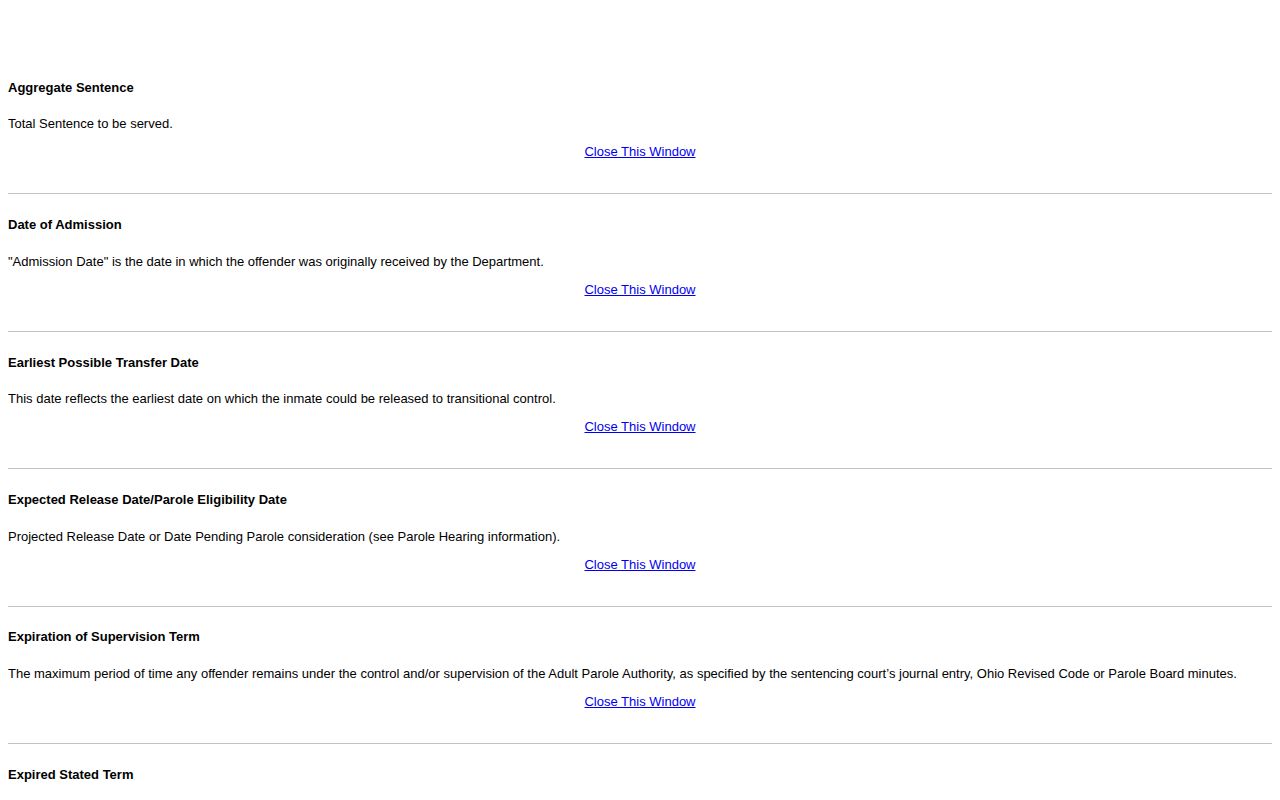
The definitions show why expected release, parole eligibility, transfer, and supervision expiration should never be treated as the same event.
Find an Ohio Projected Release Date
Begin with the ODRC offender search for a person serving an Ohio state-prison sentence. Search by offender number when possible. It is more precise than a name. ODRC requires an A, R, or W prefix and six digits; a five-digit number assigned to a woman takes a leading zero. A name search may start with the last name alone. Too many criteria can suppress a valid match, so add filters only after a broad search produces too many results.
- Open the official search and choose the status that best fits the known custody phase.
- Enter the offender number, or begin with a last name and then narrow the results.
- Match the profile with birth date, county of commitment, docket, offense, admission, and sentence.
- Locate Expected Release Date/Parole Eligibility Date, then identify which half of that label fits the sentence.
- Read Status, Parole or Release Detail, POA/PRD Date, and supervision fields before drawing a conclusion.
The ODRC search form provides status, name, offender-number, county, residential, and hearing filters.
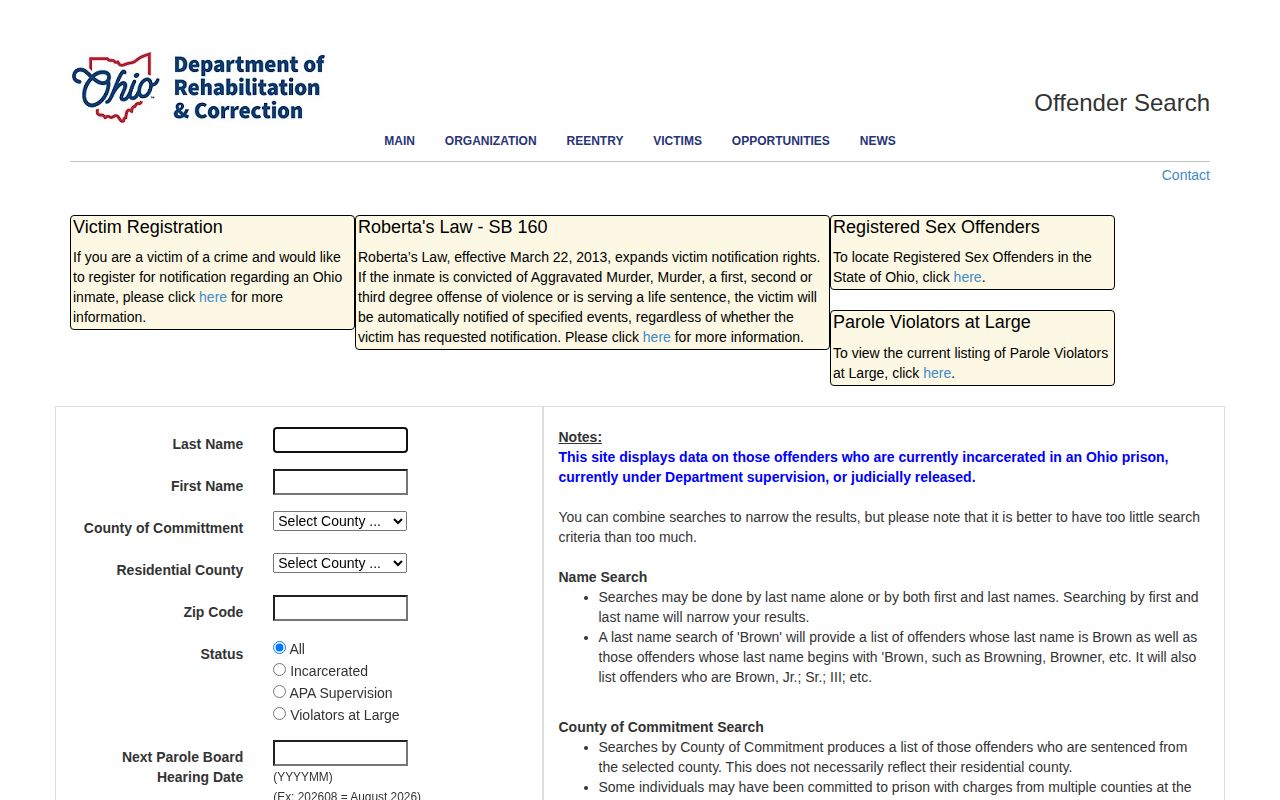
Use only the filters needed to isolate the correct person, then confirm the identity inside the detailed record.
The ODRC offender search record has a full field-by-field explanation of released, judicial-release, APA, and terminal statuses. County of commitment is the sentencing origin, not a current location. A residential county or ZIP on an APA record is last-recorded supervision information and may lag.
Ohio Release Date Fields Differ
Several ODRC fields can contain a date, but each answers a different question. Expected Release Date/Parole Eligibility Date is the main public label. POA/PRD Date means parole on or after/projected release date. Earliest Possible Transfer Date concerns a transfer threshold, while TC/TT Sentence Expiration concerns transitional-control or related sentence timing. Supervision expiration is later than prison exit when APA supervision follows. A blank field should remain blank; it should not be replaced with the nearest visible date.
| Date field | Question it answers | What it does not prove |
|---|---|---|
| Expected Release Date/Parole Eligibility Date | Expected sentence exit or eligibility for Board review, depending on the sentence | That release was approved or completed |
| POA/PRD Date | A parole-on-or-after or projected-release marker | An actual gate date |
| Earliest Possible Transfer Date | The earliest indicated transfer point | Release to the community |
| TC/TT Sentence Expiration | A transitional-control or sentence-expiration measure | Final discharge from all authority |
| Supervision Expiration | The planned end of an APA supervision term | That prison custody continues until that day |
| Parole or Release Detail | The recorded release or parole event after it occurs | That no other agency has a hold |
The official APA and projected-release detail shows how a prison date can sit beside community-supervision information.
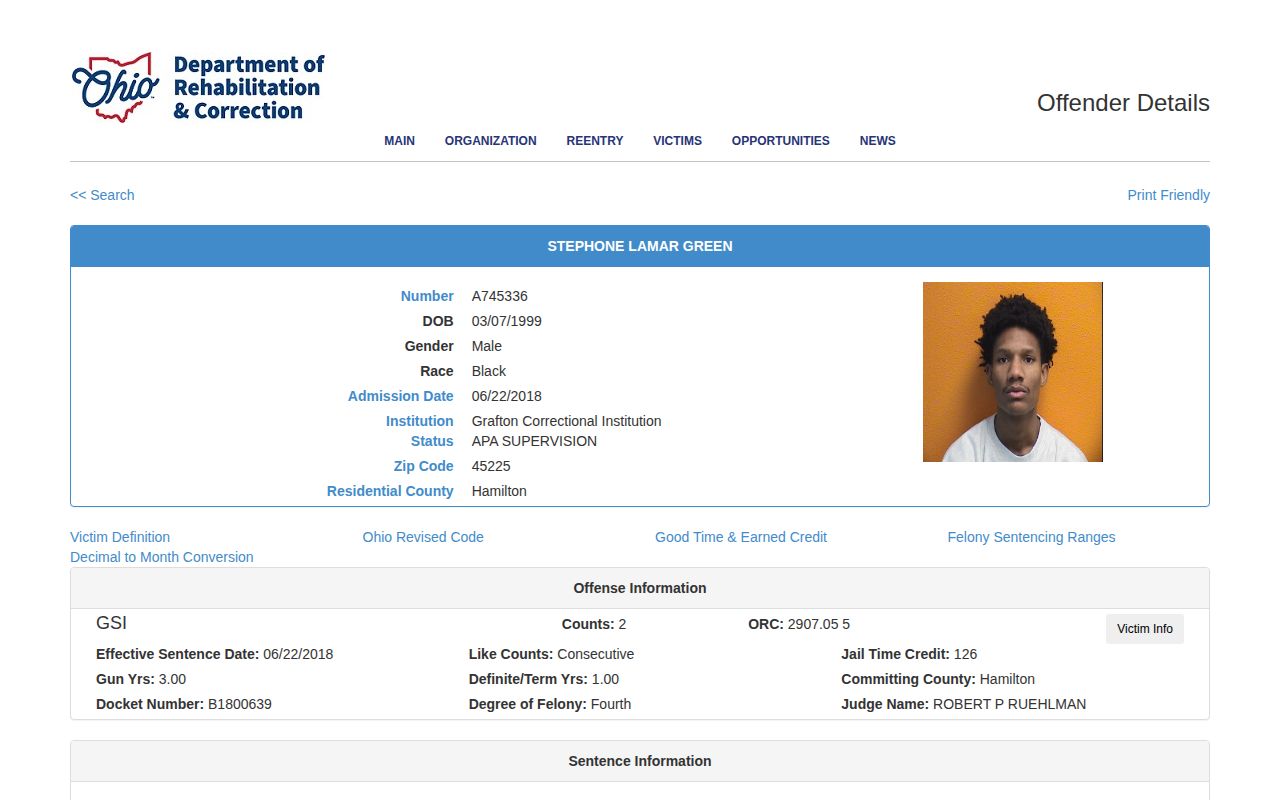
Status resolves the present custody phase, while the institution may describe the last prison rather than a current residence.
Ohio Earned Credit Changed
Ohio changed the operative earned-credit statute for qualifying confinement on and after April 4, 2024. ORC 2967.194 governs that period. ORC 2967.193 remains relevant to applicable earlier confinement. Under current law, an eligible person may provisionally earn one or five days for each completed month of productive participation. Defined program completions may support added credit in specified circumstances. Awards remain subject to exclusions, records, and administrative review.
The ordinary aggregate participation and completion category has a 15 percent ceiling on the stated term. That is a ceiling, not a promised reduction. Mandatory or nonreducible terms and several homicide, life, sex-offense, death, and Chapter 2971 categories are excluded. Other completion categories can be governed separately. The sentence and the person's eligibility must be known before a credit rule can be applied.
| Credit concept | Ohio rule | Date effect |
|---|---|---|
| Monthly productive participation | Eligible people may provisionally earn one or five days per completed month under current law | Can move the computed date within statutory limits |
| Program completion | Defined completions may qualify for added credit | May reduce eligible time after review |
| Ordinary aggregate ceiling | Generally capped at 15 percent for the covered category | Limits credit rather than guaranteeing it |
| Excluded terms | Mandatory and listed offense or sentence categories do not qualify under the ordinary rule | No reduction under that credit path |
| Jail-time credit | Credits qualifying confinement before sentence service | Adjusts the computation for time already confined |
Jail-time credit under ORC 2967.191 is distinct from earned credit. It accounts for qualifying pre-sentence confinement. It is not a reward for participation. Corrected jail credit, later awards, withdrawal of provisional credit, or a new legal ruling can change the date ODRC displays.
No Universal Ohio 85 Percent Rule
Ohio does not have one rule that every inmate serves 85 percent of every sentence. The 15 percent figure in the ordinary earned-credit structure is a maximum for a defined eligible category. It does not mean each person receives that amount. Some people earn less. Some sentence portions are mandatory or otherwise excluded. Different statutes can apply based on the offense, sentence date, sentence form, and confinement period.
Reverse-engineering a projected release date by subtracting 15 percent from the stated term can therefore produce a false result. It may ignore mandatory time, a life or indefinite structure, jail-time credit, program eligibility, disciplinary action, court corrections, consecutive terms, or a parole decision. The judgment entry and ODRC computation control the official date record.
Note: Treat earned credit as one input to a sentence computation, not as a statewide promise of early release.
Reagan Tokes Release Date Logic
Reagan Tokes non-life indefinite sentences use minimum and maximum boundaries. Under ORC 2967.271, covered sentences carry a presumption of release at the minimum term. That presumption may be rebutted through statutory procedures, and continued confinement may occur within the maximum-term limit. A minimum date is therefore not an unconditional release appointment.
This framework differs from parole eligibility for covered life and older indefinite sentences. ORC 2967.13 sets category-specific parole-eligibility rules, including several minimum-term and full-year structures. In that setting, the date authorizes Board consideration. It does not presume or require release. Life without parole and specified Chapter 2971 cases do not follow the ordinary eligibility route.
- Minimum term
- The lower boundary for a covered non-life indefinite sentence and the point tied to the statutory release presumption.
- Maximum term
- The outer sentence boundary for continued confinement under the applicable process.
- Parole eligibility
- The date an eligible case may be considered by the Ohio Parole Board, not a release grant.
- Definite term
- A fixed prison term that follows its own computation, credit, and release rules.
The sentence type must be identified before reading ODRC's combined expected-release and parole-eligibility field. Neither framework is a safe do-it-yourself calculation. An official computation, judgment entry, and current ODRC profile provide the needed context.
Why Ohio Release Dates Move
A projected date can move for administrative, legal, or conduct-based reasons. Some changes reduce the remaining time. Others extend it or show that the original display was incomplete. A detainer is a request or notice from another authority that may affect where a person goes next. It can prevent a prison exit from becoming release to the community, even if the ODRC sentence phase ends.
| Change | Possible effect | Best confirmation |
|---|---|---|
| Earned-credit award | May advance the computed date for an eligible term | Current ODRC computation |
| Credit loss or withdrawal | May move the projected date later | ODRC record and administrative decision |
| Corrected jail-time credit | Can change time credited for prior confinement | Court entry and ODRC computation |
| Appeal or new court order | May alter the sentence or custody authority | Sentencing-court docket |
| Parole grant, denial, or continuance | Can determine or defer release for a parole-eligible sentence | Board result and person detail |
| Detainer or transfer | May send the person to another custodian instead of the community | Releasing and receiving agencies |
| Reagan Tokes proceeding | May rebut release at the minimum term within statutory limits | ODRC notice and governing record |
The official Parole Board result view shows why an eligibility date must be paired with the actual review outcome.
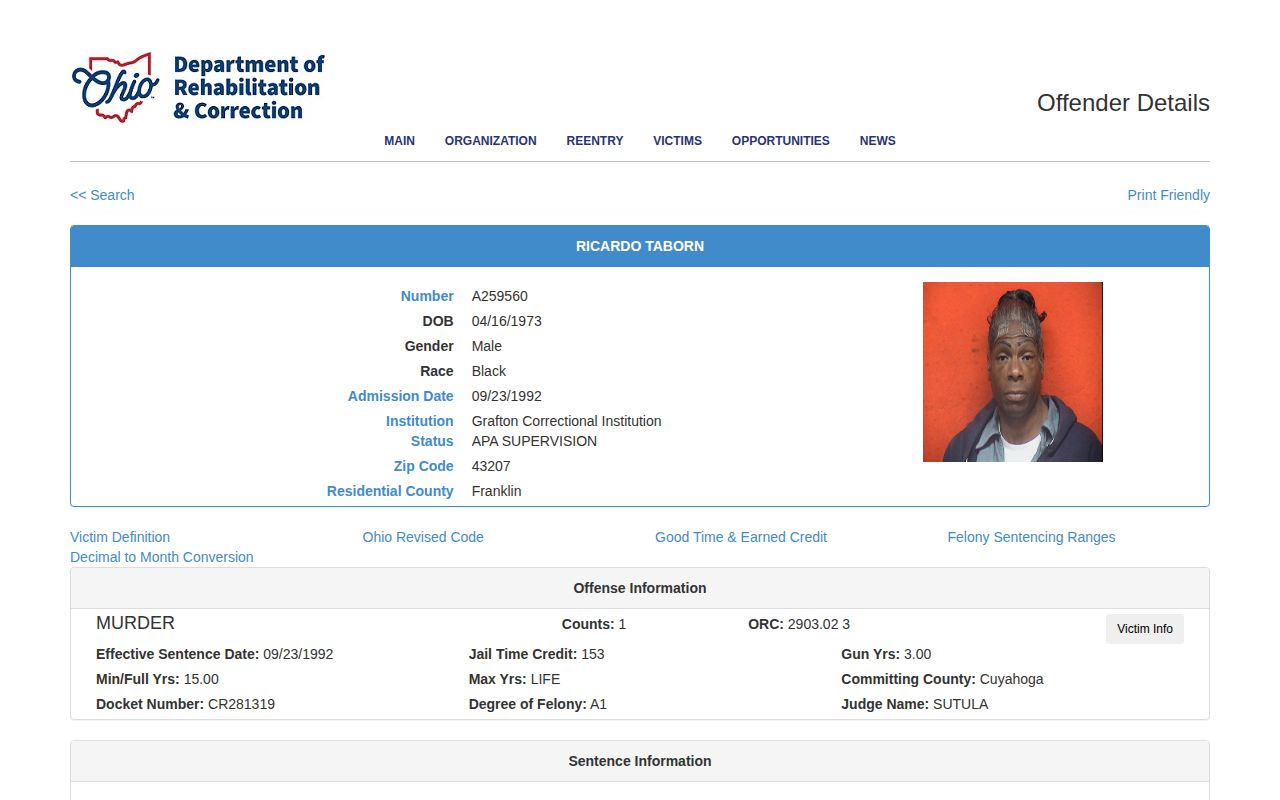
Preserve the Board's exact review type and result wording instead of turning an unfamiliar label into a release claim.
Ohio County Jail Release Dates
A county jail is not an ODRC prison. A sentenced local inmate's expected exit is computed by the jail and court under the local commitment. A pre-trial detainee has no fixed sentence-release date because the case has not reached a sentence. The next event may be bond, recognizance, dismissal, a plea, trial, transfer, or another court order. A roster disappearance can also mean transfer rather than release home.
Ask the jail custodian for the booking and release time, release event or type, booking identifier, and receiving agency if one is recorded. Then read the court docket for the legal order behind the movement. Ohio does not provide one public trial-court docket for all counties. The Supreme Court docket covers its own cases, while ordinary trial records remain with the county or municipal clerk.
A transfer to ODRC, another jail, federal custody, ICE, or a guarded medical setting ends the first jail episode without ending custody. The record should state the destination when available. Describing any roster exit as freedom would erase that distinction.
Confirm an Ohio Release Date
Recheck ODRC close to the expected date. Match the offender number and sentence again, since a name alone is weak proof. If the profile still shows incarceration, the future date remains projected. After release, look for a changed status and populated Parole or Release Detail. If APA Supervision appears, prison custody ended but state supervision continues. Final discharge may occur later.
The official released-result print layout demonstrates how a completed released-family status differs from a future calculation.
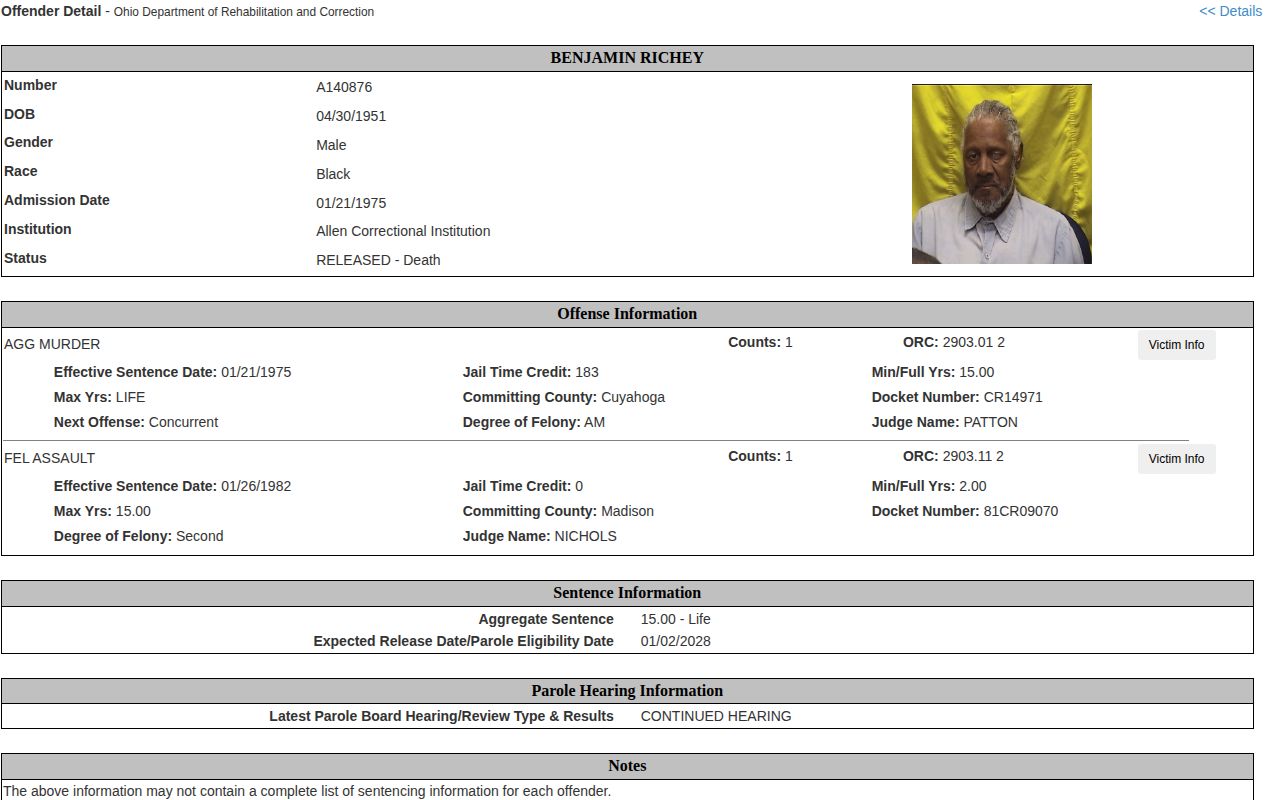
An exact terminal label should be kept as published because a suffix can narrow the meaning of the release record.
For notice of a custody event, Ohio VINE can add an alert, but it is source-fed notification rather than a certified release record. The Ohio VINELink check explains person matching and notification registration. Confirm the event with the reporting jail or ODRC, especially when another hold or transfer may exist.
When the online date remains unclear, request the existing sentence computation, release chronology, or parole detail from ODRC Central Records. Include the full name, offender number, birth date, county of commitment, docket, and approximate custody span. For a local sentence, ask the jail and sentencing court. The office need not create a fresh calculation just because a requester asks when someone will leave.
Verify Ohio Release Date Meaning
One date rarely answers every custody question. Start by naming the system: ODRC prison, county jail, federal prison, or immigration detention. Identify the sentence structure next. Then decide whether the displayed value is an estimate, parole eligibility, transfer threshold, supervision expiration, or an event already recorded. Finish by checking whether another custodian or supervision authority remains.
- Match the person with stable identifiers, not a name or image alone.
- Read the exact date-field label and current custody status together.
- Separate earned credit from jail-time credit and mandatory sentence portions.
- Distinguish Reagan Tokes minimum-term logic from life-sentence parole eligibility.
- Check Parole or Release Detail for an event that has actually occurred.
- Confirm a transfer or detainer before calling the movement a community release.
A projected date is useful when its limits stay visible. The current ODRC profile, the judgment entry, and an official computation are the strongest sources for a state sentence. A later status and release detail confirm the event. For county custody, the jail movement record and court order provide the parallel proof.